
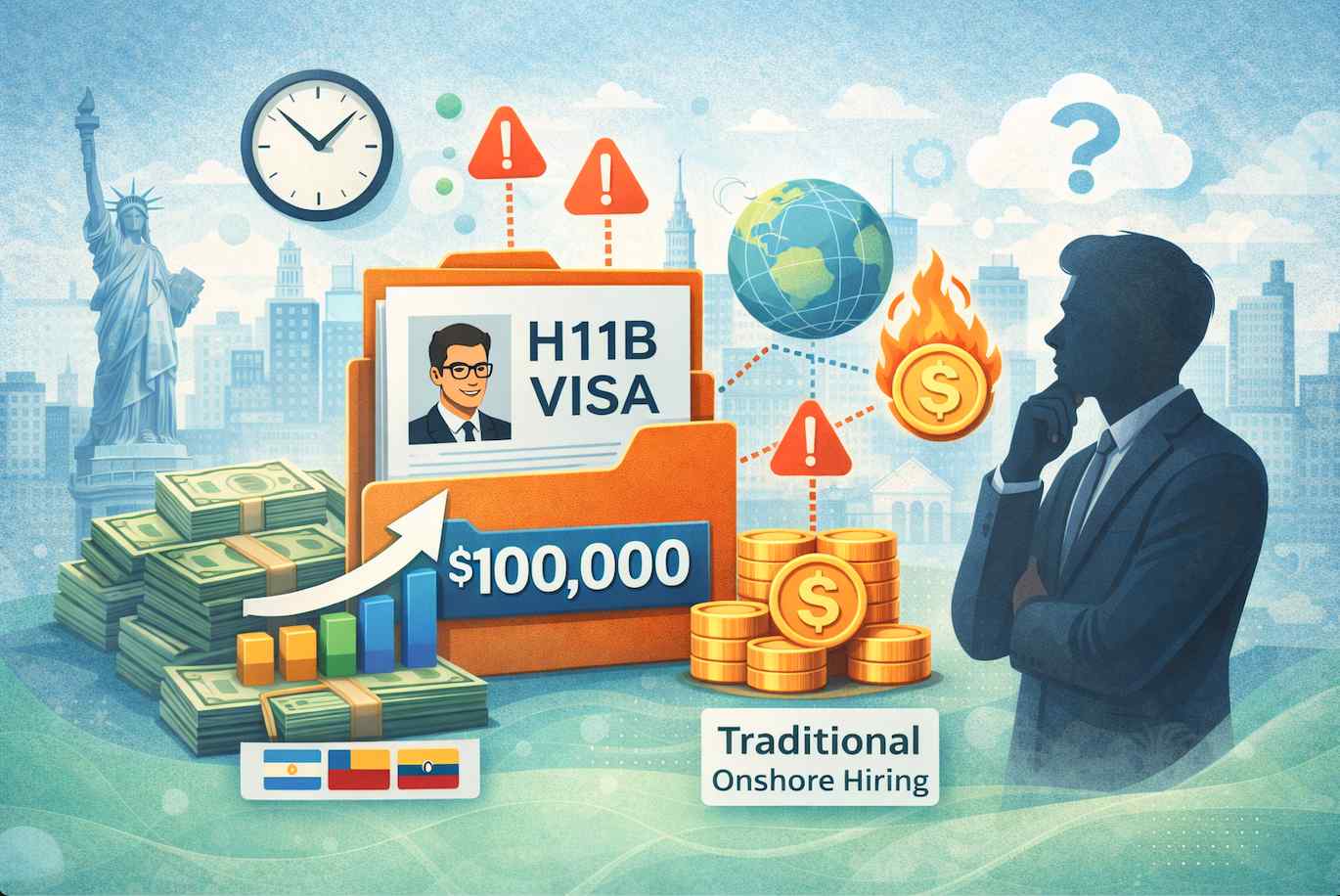
In September 2025, the landscape of U.S. tech hiring changed overnight. A new policy imposed a one-time $100,000 fee on new H1B visa petitions—up from the previous $2,000-$5,000 range. For companies that relied on H1B workers to fill critical roles, the math suddenly became untenable.
This wasn't a gradual policy shift companies could plan around. It was immediate, disruptive, and has already triggered a fundamental reassessment of how U.S. companies access international technical talent.
Understanding the Impact
The numbers tell the story clearly. JPMorgan economists estimate the new fee could reduce immigrant work authorizations by 5,500 each month, with technology firms and Indian professionals—who historically received over 70% of H1B visas—bearing the heaviest impact.
For context: employers previously paid between $2,000 to $5,000 per H1B petition depending on company size. The jump to $100,000 represents a cost increase of 2,000-5,000 percent for accessing the same talent through the same visa category.
The fee applies specifically to new H1B petitions for workers currently abroad. While renewals and status changes for workers already in the U.S. are exempt, the policy effectively closes off the primary entry point for new international technical talent through traditional channels.
The Immediate Business Implications
Companies now face an impossible calculation. For a single software engineer position, you're comparing:
Onshore U.S. hire: Market-rate salary plus standard employment costs
H1B hire: Market-rate salary plus $100,000 visa fee plus legal and compliance costs
Alternative international model: Competitive compensation without visa fees or caps
The economics are stark. Unless a role absolutely requires U.S. presence and cannot be filled domestically, the H1B path has become prohibitively expensive for most companies—particularly startups and mid-size firms operating on controlled budgets.
Even major tech companies are reconsidering. When you're hiring dozens or hundreds of developers annually, absorbing $100,000 per new international hire fundamentally changes workforce planning and budget allocation.
Where Work Goes When Visas Don't
The policy doesn't eliminate the need for technical talent—it redirects where that work happens. Research shows a near 1:1 offshoring substitution: when a visa isn't approved, the job often gets done offshore.
This creates three emerging patterns:
Complete offshoring: Companies shift entire functions to international offices or contractors, accepting the collaboration challenges that come with significant timezone differences and asynchronous workflows.
Nearshore pivoting: Companies discover Latin America as the middle ground—international talent without visa complexity, with timezone alignment that offshore can't provide.
Hybrid models: Critical onshore leadership with broader engineering capacity distributed across accessible international markets.
The Nearshore Advantage in the New Reality
This is where nearshore Latin America has moved from "interesting option" to "strategic imperative" for many companies.
The value proposition is straightforward: access technically strong developers in Argentina, Colombia, Brazil, or Mexico without visa fees, without lottery uncertainty, and without the $100,000 barrier that just appeared overnight.
Cost structure that works: Nearshore compensation remains highly competitive with U.S. markets while avoiding the visa premium entirely. You're investing in talent, not immigration bureaucracy.
Timeline predictability: Need a senior developer? Latam Staffers can present pre-vetted candidates within days and have them contributing in weeks. No lottery, no waiting periods, no uncertainty about whether you'll actually be able to hire the person you want.
Collaboration quality: Unlike fully offshore models, Latin American developers work within a few hours of U.S. time zones. Your team can do morning standups, have real-time technical discussions, and solve problems synchronously—the same collaboration quality you'd expect from domestic teams.
Legal simplicity: Standard employment relationships managed through established frameworks. No immigration petitions, no federal fee structures subject to sudden policy changes, no compliance burden unique to visa programs.
What Companies Are Doing Right Now
The policy went into effect in late September 2025. The response has been immediate:
Companies with pending H1B candidates have had to make rapid decisions—absorb the $100,000 cost, lose the candidate, or pivot to alternative models.
HR teams are being asked to present international hiring strategies that don't depend on H1B access. The conversation has shifted from "how do we navigate H1B successfully?" to "what models let us access international talent without visa dependency?"
Startups that previously planned on H1B for key technical hires are discovering they simply cannot afford it. The $100,000 fee represents meaningful runway for early-stage companies—the choice between hiring an international developer onshore versus building an entire nearshore team becomes obvious.
Even established companies are questioning why they'd pay the premium when technically equivalent talent is available through models that don't require it.
The Strategic Shift
This policy change has accelerated a transition that was already underway. Remote work proved distributed teams could be highly effective. The talent shortage in U.S. markets was already pushing companies to look internationally. Latin American tech ecosystems have matured significantly.
The $100,000 H1B fee simply removed any remaining ambiguity about whether alternative models make strategic sense.
For companies building or scaling engineering teams, the question is no longer "should we consider nearshore?" It's "why would we pay $100,000 per hire when we don't have to?"
Building Teams in the New Environment
At Latam Staffers, we're seeing this shift in real-time. Companies that were exploring nearshore as one option among several are now treating it as their primary international hiring strategy.
The value we provide has become more critical: pre-vetted technical talent ready to contribute immediately, managed employment relationships that eliminate cross-border complexity, and rapid deployment timelines that let companies move forward rather than waiting on visa outcomes.
The developers we place aren't "H1B alternatives"—they're excellent engineers who happen to be accessible without visa barriers. They bring the same technical strength, modern development practices, and collaborative mindset that made H1B candidates attractive, but through an engagement model that actually works in 2025's policy environment.
Looking Forward
Policy can change again. The $100,000 fee could be modified, challenged legally, or adjusted in future administrations. But the broader trend is clear: visa-dependent international hiring has become complicated, expensive, and unreliable as a core talent strategy.
Companies that build flexibility into their hiring models—accessing great developers wherever they are through frameworks that don't depend on visa lottery outcomes or sudden fee increases—are positioning themselves to compete effectively regardless of what policy changes come next.
Latin America offers that flexibility. Strong technical talent, cultural and timezone alignment with U.S. business practices, and engagement models that provide predictability rather than uncertainty.
The $100,000 H1B fee didn't create the nearshore opportunity—it just made it impossible to ignore.